How to Reduce No-Shows: 10 Proven Strategies for Service Businesses

How to Reduce No-Shows: 10 Proven Strategies for Service Businesses Appointment no-shows cost service businesses between 5% and 30% of their total revenue every year. For a salon generating $15,000 per month, even a 10% no-show rate means $18,000 lost annually in empty chairs, wasted staff time,...

How to Reduce No-Shows: 10 Proven Strategies for Service Businesses

How to Reduce No-Shows: 10 Proven Strategies for Service Businesses

Appointment no-shows cost service businesses between 5% and 30% of their total revenue every year. For a salon generating $15,000 per month, even a 10% no-show rate means $18,000 lost annually in empty chairs, wasted staff time, and missed opportunities.

The good news: no-shows are not random. They follow predictable patterns, and the businesses that reduce no-shows most effectively use a combination of communication, policy, and technology rather than relying on any single fix.

This guide breaks down 10 proven strategies to reduce your no-show rate, explains why each one works, and shows you how to implement them starting today.

What Is a No-Show and Why Does It Happen?

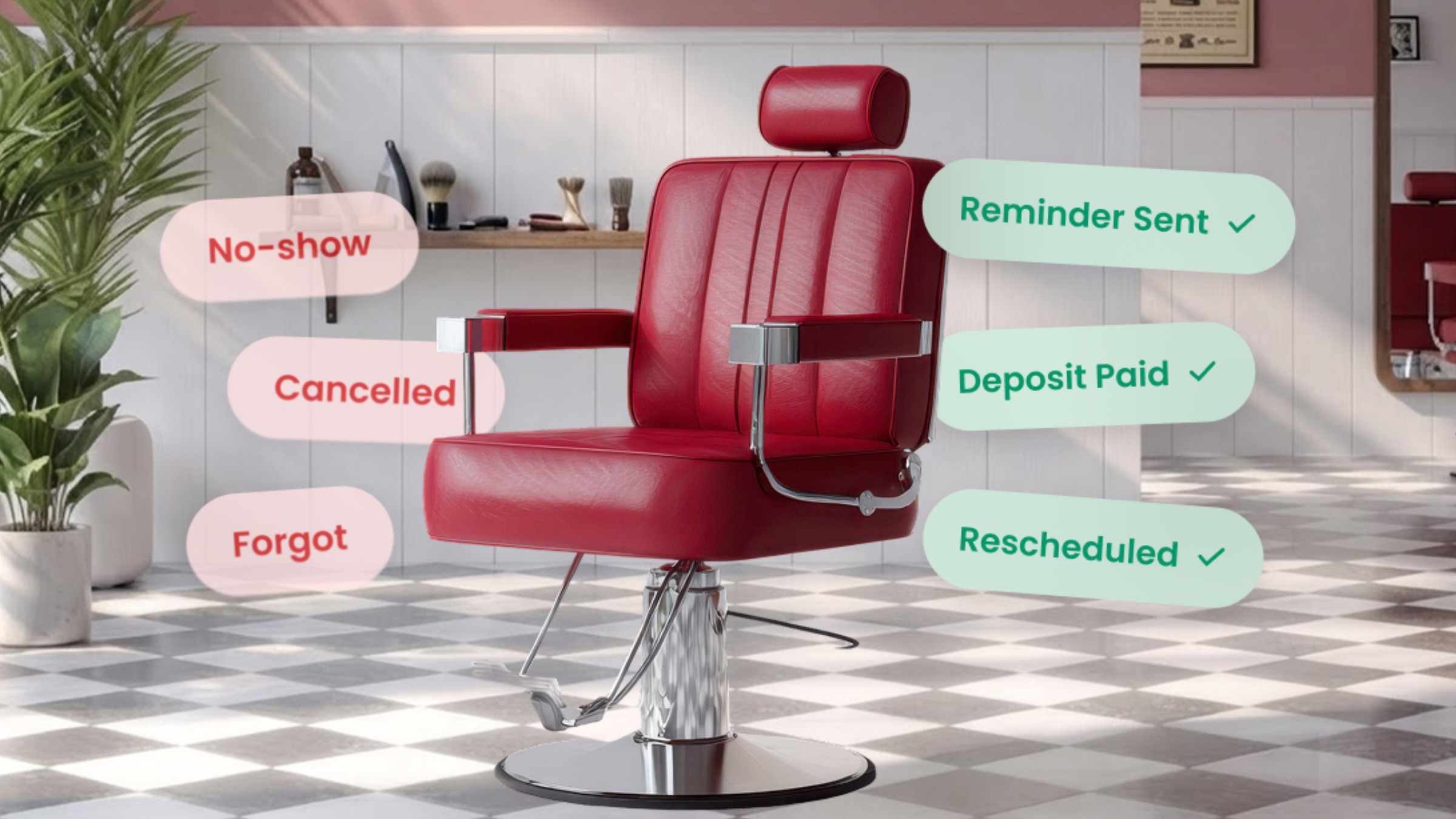
A no-show happens when a client fails to attend a booked appointment without canceling or rescheduling in advance. Unlike late cancellations, no-shows give the business zero notice and zero chance to fill the slot.

Understanding why clients no-show is the first step to fixing the problem. Research from the healthcare and service industries points to several consistent causes:

Forgetfulness accounts for roughly 40% of all no-shows. Clients book days or weeks ahead and simply forget. This is the easiest cause to fix because automated reminders solve it directly.

Schedule conflicts arise when something comes up and the client either forgets to cancel or does not know how. If canceling requires a phone call during business hours, many clients will just skip the appointment instead.

Cost anxiety or buyer's remorse happens when a client books impulsively and later second-guesses the expense. This is more common with higher-priced services like cosmetic treatments, consulting sessions, or premium spa packages.

Low perceived commitment is the hidden driver. When booking is frictionless and free, some clients treat appointments casually. They have nothing at stake if they do not show up.

Poor experience or low trust means the client had a previous visit that did not meet expectations, or they are a first-time client with no relationship with the business yet.

Each of the 10 strategies below targets one or more of these root causes.

1. Send Automated Appointment Reminders (SMS, Email, and WhatsApp)

Automated reminders are the single most effective tool to reduce no-shows. Studies across healthcare, beauty, and professional services consistently show that SMS reminders alone reduce no-show rates by 29% to 39%.

The key is timing and channel:

  • 48 hours before: Send the first reminder by email. This gives the client time to reschedule if needed, which is better for your business than a last-minute cancellation.
  • 24 hours before: Send an SMS or WhatsApp message. Text messages have a 98% open rate compared to 20% for email, making them far more reliable for short-notice reminders.
  • 2 hours before: Send a final SMS for same-day appointments. This catches clients who read the earlier message but forgot to act.

A booking system like SimplyBook.me lets you configure multi-channel reminder sequences that fire automatically when appointments are booked. You set it up once, and every client gets the right message at the right time without your staff doing anything manually.

Pro tip: Personalize the message. Include the client's first name, the service they booked, and the provider's name. Generic messages like "You have an upcoming appointment" perform significantly worse than "Hi Sarah, just a reminder about your haircut with James tomorrow at 2pm."

2. Make Canceling and Rescheduling Easy

This sounds counterintuitive, but making it easier to cancel actually reduces no-shows. Here is why: a cancellation gives you a chance to fill the slot. A no-show does not.

Many businesses accidentally increase their no-show rate by making cancellation difficult. If the only way to cancel is by calling during business hours, clients who realize they cannot make it at 10pm will not call. They will just not show up.

The fix:

  • Include a one-tap "Cancel" or "Reschedule" link directly in every reminder message
  • Offer self-service rescheduling through your online booking page so clients can move their appointment without calling
  • Set a clear cancellation window (for example, 24 hours before) and communicate it in every confirmation and reminder

When clients can reschedule in 30 seconds from their phone, they are far more likely to do it. That freed-up slot then becomes available for other clients to book, and you recover revenue that would have been lost to a silent no-show.

3. Require Online Prepayment or Deposits

Charging a deposit or requiring full prepayment at the time of booking is one of the most powerful ways to reduce no-shows because it addresses the root cause of low commitment.

When a client has paid money upfront, their psychological commitment to the appointment increases dramatically. Behavioral economics research calls this the "sunk cost effect" and it works heavily in your favor here.

How to implement deposits without scaring away clients:

  • Start with high-value services. Require a 20-50% deposit for services above a certain price threshold. A $200 facial treatment warrants a $50 deposit. A $30 haircut may not.
  • Frame it as securing their spot. Language matters. "Pay a small deposit to guarantee your appointment time" feels different from "We charge you if you do not show up."
  • Apply the deposit to the final bill. Make it clear this is not an extra charge. The deposit is simply part of the payment, collected earlier.
  • Use your booking system's built-in payments. Tools like SimplyBook.me integrate with Stripe, Square, and PayPal so you can collect deposits automatically when clients book online. No manual invoicing needed.

Businesses that implement deposit requirements typically see no-show rates drop by 40% or more, particularly for premium and first-time bookings.

4. Implement a Clear No-Show and Cancellation Policy

A written no-show policy sets expectations before the appointment ever happens. It gives you grounds to charge fees, and more importantly, it signals to clients that your time has value.

An effective no-show policy includes:

  • The cancellation window: How far in advance must a client cancel to avoid a fee? 24 hours is standard for most service businesses. High-demand services like medical consultations or specialized treatments may require 48 hours.
  • The consequence: What happens if they no-show? Common options include a flat fee ($25-50), the full service price, loss of their deposit, or being required to prepay for future bookings.
  • Exceptions: Build in reasonable flexibility. First-time offenders might get a warning. Emergencies happen. Rigid policies create resentment. Consistent but empathetic enforcement builds respect.

Display your policy on your booking page, include it in confirmation emails, and reference it in reminder messages. The goal is not to punish clients but to make sure they understand the impact of a no-show before they book.

5. Use Waitlists to Fill Canceled Slots Automatically

Even with the best prevention strategies, some cancellations and no-shows will still happen. A waitlist system turns those lost slots into recovered revenue.

Here is how a waitlist works in practice:

  1. A client cancels their 3pm Tuesday appointment
  2. Your booking system automatically notifies the next person on the waitlist that the slot is now available
  3. The waitlist client books the newly opened slot within minutes

Without a waitlist, your staff would need to manually call clients to try filling gaps, which rarely happens during a busy day. With an automated waitlist, the system handles it instantly.

SimplyBook.me's waitlist feature sends automatic notifications when slots open up, so your calendar stays full even when plans change.

The key metric: Track your "fill rate" for canceled slots. If you are filling fewer than 50% of cancellations, your waitlist process needs improvement, either by growing the waitlist itself or by shortening notification times.

6. Confirm Appointments and Require Active Confirmation

Sending a confirmation is standard. Requiring the client to confirm back is the upgrade that makes a real difference.

Active confirmation means the client must reply "Yes" or tap a "Confirm" button in response to your reminder. This does two things: it verifies the client actually intends to come, and it creates a micro-commitment that increases follow-through.

Clients who actively confirm their appointment are significantly less likely to no-show than clients who passively receive a reminder without responding.

Set up your system so that unconfirmed appointments trigger a follow-up. If a client has not confirmed 12 hours before their appointment, your team knows to either call them or release the slot to someone on the waitlist.

7. Offer Flexible Booking Options (Online, 24/7)

Clients who book on their own terms tend to keep their appointments. When someone chooses a time that fits their schedule perfectly (rather than accepting whatever slot the receptionist offered over the phone), they are more committed from the start.

Online booking that is available 24/7 lets clients:

  • Browse real-time availability and pick the time that truly works for them
  • Book at midnight, on weekends, or during their lunch break rather than being limited to your business hours
  • Reschedule instantly if their plans change

This is where a customizable booking widget on your website and social media pages becomes essential. SimplyBook.me lets you embed booking on your website, Instagram, Facebook, and Google Business Profile so clients can book wherever they find you, at any hour.

The data supports this: businesses that switch from phone-only booking to 24/7 online booking typically see a measurable drop in no-show rates because clients self-select times they can actually attend.

8. Build Relationships and Personalize the Experience

Clients are less likely to no-show on a person they know and respect than on a faceless business. Relationship building is a long-game strategy, but it compounds over time.

Practical ways to strengthen client relationships:

  • Use their name in every communication, not just reminders but follow-up messages, birthday greetings, and loyalty rewards
  • Remember their preferences. A booking system with client profiles helps your team recall details like preferred services, past treatments, or scheduling patterns
  • Follow up after appointments. A simple "Thanks for coming in, Sarah. Hope you love the new color!" message after a visit builds loyalty and makes the next appointment feel personal
  • Assign consistent providers. When a client sees the same stylist, therapist, or trainer every visit, the relationship creates accountability on both sides

First-time clients have the highest no-show rates because they have no relationship with your business yet. Consider sending first-time clients an extra welcome message before their appointment that introduces their provider, explains what to expect, and shows them where to park. Reducing uncertainty reduces no-shows.

9. Analyze Your No-Show Data and Identify Patterns

Not all no-shows are equal. Patterns exist in your data, and finding them lets you target your prevention efforts where they matter most.

Questions to investigate:

  • Which days and times have the highest no-show rates? Monday mornings and Friday afternoons are common problem slots. You might overbook these slightly or require deposits specifically for high-risk times.
  • Are certain services more prone to no-shows? Free consultations and low-cost introductory offers tend to have higher no-show rates because the client has less at stake.
  • Do first-time clients no-show more than regulars? Almost always yes. This means your first-time client communication sequence should be more robust.
  • Is there a booking lead time pattern? Appointments booked far in advance (3+ weeks) typically have higher no-show rates than those booked within the next week. Longer lead times mean more reminder touchpoints are needed.

Pull reports from your booking system regularly. SimplyBook.me provides analytics on no-show rates, cancellation patterns, and client behavior so you can make data-driven decisions rather than guessing.

10. Reward Clients Who Show Up Consistently

Most businesses focus exclusively on penalizing no-shows. Flipping the script to reward reliability can be equally powerful.

Ideas for rewarding consistent attendance:

  • Loyalty points for kept appointments. After 10 appointments without a no-show, offer a discount or a free add-on service
  • Priority booking access. Give reliable clients first access to popular time slots or new services
  • Exclusive perks. A complimentary upgrade, a small gift, or a handwritten thank-you note goes a long way
  • Public recognition (with permission). Feature loyal clients in your social media or in-store displays

This approach works because it reframes the no-show conversation from punitive to positive. Instead of "We will charge you if you miss," it becomes "We appreciate you and want to reward you for being a great client." Both approaches reduce no-shows, but the positive framing builds stronger long-term loyalty.

How to Calculate Your No-Show Rate

Before you can improve, you need to measure. Your no-show rate is straightforward:

No-Show Rate = (Number of No-Shows / Total Booked Appointments) x 100

For example, if you had 200 appointments last month and 18 were no-shows, your no-show rate is 9%.

Industry benchmarks for reference:

  • Hair salons and barbershops: 15-25% average, well-managed salons achieve under 10%
  • Health and wellness clinics: 10-20% average
  • Fitness and personal training: 15-30% average
  • Professional services (consulting, coaching): 10-15% average

Track this monthly and by provider, service type, and client segment. A 5% reduction in no-shows for a busy salon can mean thousands of dollars recovered per quarter.

Building Your No-Show Prevention Stack

No single strategy eliminates no-shows entirely. The most effective approach is layering multiple strategies together into a prevention stack.

A solid starting stack for most service businesses:

  1. Automated reminders at 48 hours, 24 hours, and 2 hours (addresses forgetfulness)
  2. Easy self-service rescheduling via booking links in reminders (captures cancellations before they become no-shows)
  3. Deposits for high-value bookings or first-time clients (increases commitment)
  4. A clear, visible no-show policy on your booking page and in confirmations (sets expectations)
  5. Monthly no-show rate tracking to measure progress and spot patterns

Start with these five. Once they are running, layer in waitlists, active confirmation, loyalty rewards, and data-driven scheduling adjustments.

The right booking software makes the difference between a prevention stack that runs itself and one that creates more admin work. SimplyBook.me handles automated reminders, online payments, waitlists, cancellation policies, and reporting in one platform, so you can set up your prevention stack once and let it work in the background while you focus on your clients.

Start your free trial at SimplyBook.me and see how much revenue you can recover by reducing no-shows this month.

Frequently Asked Questions

What is a good no-show rate for a service business?

A no-show rate under 10% is considered good for most service industries. Top-performing businesses that use automated reminders, deposits, and clear policies often achieve rates between 3% and 7%. If your rate is above 15%, there is significant room for improvement.

Do appointment reminders actually reduce no-shows?

Yes. SMS appointment reminders are the single most studied and proven method to reduce no-shows. Research across multiple industries shows that SMS reminders reduce no-show rates by 29% to 39%. Multi-channel reminders (combining SMS, email, and WhatsApp) perform even better than any single channel alone.

Should I charge a fee for no-shows?

A no-show fee can be effective, but it works best as part of a broader strategy. Charging fees alone can alienate clients if not handled carefully. The most effective approach combines prevention (reminders, easy rescheduling) with consequences (deposits, cancellation fees) and communicates the policy clearly before it is ever enforced.

How far in advance should I send appointment reminders?

The optimal reminder sequence for most service businesses is three touchpoints: 48 hours before (email), 24 hours before (SMS or WhatsApp), and 2 hours before for same-day appointments (SMS). This gives clients multiple opportunities to confirm, reschedule, or cancel in time for you to fill the slot.

Will requiring deposits scare away new clients?

Some businesses worry about this, but the data suggests otherwise. Clients who are serious about their appointment are willing to pay a small deposit, especially when it is framed as securing their preferred time slot. The clients you lose to a deposit requirement are often the same ones who would have no-showed anyway.

How do I handle repeat no-show offenders?

Start with a conversation, not a penalty. Contact the client, acknowledge the pattern, and ask if something about the booking process is not working for them. If the behavior continues, require prepayment for future appointments or move them to a waitlist-only basis where they can book last-minute slots that might otherwise go unfilled.

Can online booking reduce no-shows compared to phone booking?

Yes. Clients who book online tend to no-show less because they actively choose a time that works for their schedule rather than accepting a slot offered by a receptionist. Online booking also makes it easier to reschedule, which converts potential no-shows into kept appointments.

What is the difference between a no-show and a late cancellation?

A no-show means the client did not appear and gave no notice. A late cancellation means the client canceled inside your cancellation window (for example, less than 24 hours before). Both cost you revenue, but late cancellations at least give you a small window to fill the slot. Your policy should address both, with no-shows typically carrying a higher consequence.

Unlock exclusive content

Get booking tips, product updates, and inspiring stories to help you grow your service business — straight to your inbox